
In Citizenship Clause litigation is an 1812 Supreme Court opinion the “subject to the jurisdiction” decoder ring?
The Citizenship Clause, Consuls, and Indians

It will take all the Supreme Court’s acuity to reconcile two propositions advanced by litigants challenging the President’s executive order on citizenship at birth1 in Trump v. Barbara.
The first of these propositions2 from the respondents in Barbara is that the Supreme Court established in Wong Kim Ark that the meaning of “subject to the jurisdiction thereof” in the Citizenship Clause3 is elucidated by The Schooner Exchange,4 an 1812 opinion from Chief Justice John Marshall:
As the Court explained, the words “subject to the jurisdiction thereof” in the Clause “must be presumed to have been understood and intended by the congress which proposed the amendment, and by the legislatures which adopted it, in the same sense in which the like words had been used by Chief Justice Marshall in the well[-]known case of The Exchange.” Wong Kim Ark, 169 U.S. at 687.5
The second proposition is that the term “subject to the jurisdiction thereof” in the Citizenship Clause accounts for the Clause not granting citizenship at birth to children of foreign ambassadors, “children of members of the Indian tribes owing direct allegiance to their several tribes,” and two or three other groups listed in Wong Kim Ark:6
To capture the narrow set of English common-law exceptions, and the single additional American exception for Native Americans, see infra Part II.B, the Framers used the term “subject to the jurisdiction” to reflect the meaning elaborated in Exchange.7
How the Supreme Court’s Citizenship Clause jurisprudence denying citizenship at birth to members of Indian tribes8 can survive glossing “subject to the jurisdiction thereof” by reference to The Exchange remains mysterious. Further, Barbara respondents’ 11th-hour argument that the Citizenship Clause’s exclusions “all rest on inter-sovereign dynamics inapplicable to ordinary foreign nationals”9 should occasion overdue scrutiny of the Citizenship Clause’s treatment of the U.S.-born children of foreign consular officials.
Postulate #1: In The Exchange’s parlance, members of Indian tribes do not enjoy “an exemption from the jurisdiction of the sovereign,“ but are “amenable to the laws of the place”10
In The Exchange, groups either enjoyed “an exemption from the jurisdiction of the sovereign” or were “amenable to the laws of the place.”11 The Exchange indicated that extending transit rights to a foreign army “implies a waiver of all jurisdiction over the troops, during their passage.”12
In February, Barbara respondents read The Exchange to distinguish groups enjoying ““immunity”” from those within “the reach of the laws.”13 Last October they told the Supreme Court, “The Exchange, as Wong Kim Ark went on to explain, made clear that temporary visitors—i.e., non-domiciled noncitizens—owed this country “temporary and local allegiance” and were “amenable to the jurisdiction of the country.””14 In briefing the parties in Barbara incorporated from New Hampshire Indonesian Community Support v. Trump by stipulation,15 “subject to the jurisdiction thereof” was said to have “constitutionalized” Chief Justice Marshall’s formula from more than fifty years before:
Even if there were doubt on the common-law question, it was laid to rest when Congress adopted the term “subject to the jurisdiction.” As Wong Kim Ark explained, that choice of language constitutionalized the “clear and powerful train of reasoning,” 169 U.S. at 683, which Chief Justice Marshall articulated in The Schooner Exchange v. McFaddon, 11 U.S. 116 (1812). Justice Marshall could not have been clearer: Temporary visitors “owe temporary and local allegiance” to the United States and are “amenable to the jurisdiction of the country.” 11 U.S. at 144. Thus, as the Court in Wong Kim Ark emphasized, noncitizens are “completely subject to the political jurisdiction” of the United States, even if their presence is “temporary,” because a visitor “owes obedience to the laws of [the] government, and may be punished for treason or other crimes” for “so long a time as he continues within the dominions” of it. 169 U.S. at 693-94.16
While Barbara respondents speak of “the English common-law exceptions for children of ambassadors and the like, and the analogous American exclusion of Native American tribal members,”17 the 1st Circuit observed that the Wong Kim Ark majority opinion “explained that Chief Justice Marshall had no occasion to address “the anomalous case of the Indian tribes”” in his opinion in The Exchange.18
The government’s Supreme Court reply brief argued that “respondents’ theory is illogical,”19 in part because “[t]hey contend (Br. 16) that a person is subject to U.S. jurisdiction if he must follow U.S. law, yet agree (Br. 28) that children of tribal Indians are not constitutionally entitled to citizenship even though they must obey the law.”20 The same brief asserts that “[r]espondents’ theory cannot explain the exception to birthright citizenship for children of tribal Indians”21 and that “citizenship does not turn on whether a person must obey U.S. law—a theory that would eliminate the exception for tribal Indians recognized in Wong Kim Ark itself.”22 At oral argument, the Solicitor General insisted that Senator Lyman Trumbull “expressly and consciously…rejected reliance on Schooner Exchange.”23
Unlike foreign ambassadors or foreign armies crossing U.S. territory with permission, members of Indian tribes were liable to prosecution in American tribunals. The lack of exemption was express in an act of the Colony of Connecticut,24 while extradition provisions in various treaties presupposed that members of Indian tribes were not exempt from criminal process in states or territories.25 In contrast to “the exemption of the person of the sovereign from arrest or detention within a foreign territory”26 and the like exemption afforded foreign diplomats,27 Congress specified in an 1802 provision regarding certain crimes committed by members of friendly tribes who had entered U.S. states or territories from Indian domains28 “that nothing herein contained shall prevent the legal apprehension or arresting, within the limits of any state or district, of any Indian having so offended…”29
In 1803, the New York legislature pardoned the murder conviction of a Seneca Indian.30 Concerning that case, President Jefferson had told a Seneca delegation:
In this case the murder was committed within the lands belonging to New York, and therefore the judges of New York are the persons authorised to enquire into the truth of the fact, and to punish it, if true—And had the murder been committed at the same place by an Englishman, a Frenchman, a Spaniard (sic) an American, or a person of any other nation the same judges would have tried it, by the same rules, and subject to the same punishment; So that you are placed on the same footing, in this respect, as the most powerful & the most friendly nations are, and as we are ourselves.31
(In 1822, the New York legislature pardoned a Seneca Indian and purported to establish that members of Indian tribes were amenable to prosecution in the state’s criminal tribunals for offenses committed within tribal domains.32 In 1879, the Supreme Court of Wisconsin stated, “We have no doubt that the criminal laws of the state apply to the Indians on their reservations within this state.”)33
Writing from Detroit in 1806, the Governor of the Michigan Territory reported that “the principal Chief of the Chipawa Nation committed an outrageous murder on one of his Nation at this place.”34 Though the principal chief, who viewed the act as a legitimate function of government, was swiftly indicted,35 he “was tried and acquitted by a jury in Detroit”36 before President Jefferson’s pardon37 could wing its way to Michigan.38 No head of state or other immunity spared him from standing trial in a U.S. territory.
Under Article 5 of an 1866 treaty with the Choctaws and Chickasaws, the United States undertook to ask four states to declare a general “amnesty as to all offences committed by any member of the Choctaw or Chickasaw nation:”
A general amnesty of all past offences against the laws of the United States, committed before the signing of this treaty by any member of the Choctaw or Chickasaw nations, is hereby declared; and the United States will especially request the States of Missouri, Kansas, Arkansas, and Texas to grant the like amnesty as to all offences committed by any member of the Choctaw or Chickasaw nation.39
The Tennessee Court of Errors and Appeals wrote in 1823 that a member of the Cherokee Nation “is only then subject to our law when he comes within the limits of the State, and beyond the territories of his own nation. There he is bound to its observance upon the same principles and in the same degree as a Frenchman coming into the country would be.”40 The Kansas Supreme Court concluded in 1866 in Hunt v. State, “A Wea can claim no greater immunities against punishment for crime than a Frenchman.”41 (The Supreme Court of Nevada suggested that Hunt v. State was not consistent with subsequent jurisprudence42 when it ruled in 1883 that a member of the Shoshone tribe accused of killing another member of that tribe43 could not be tried in the state’s courts.)44 The Governor of the State of Oregon seems to have pardoned Indians for the first time in August 1869.45
Whether or not the Kansas Supreme Court was right about their amenability to state tribunals, the Wea were signatories to an 1854 treaty which included a pledge to “abide by the laws of the United States:”
They desire to be at peace with all men, and they bind themselves not to commit depredation or wrong upon either Indians or citizens; and should difficulties at any time arise, they will abide by the laws of the United States in such cases made and provided, as they expect to be protected and to have their rights vindicated by those laws.46
U.S. criminal laws reached into Indian domains, as members of Indian tribes were prosecuted in federal courts for acts committed there. In November 1828, President John Quincy Adams pardoned two Indians47 who had been charged48 and convicted49 in the Michigan Territory pursuant to the General Crimes Act of 1817.50
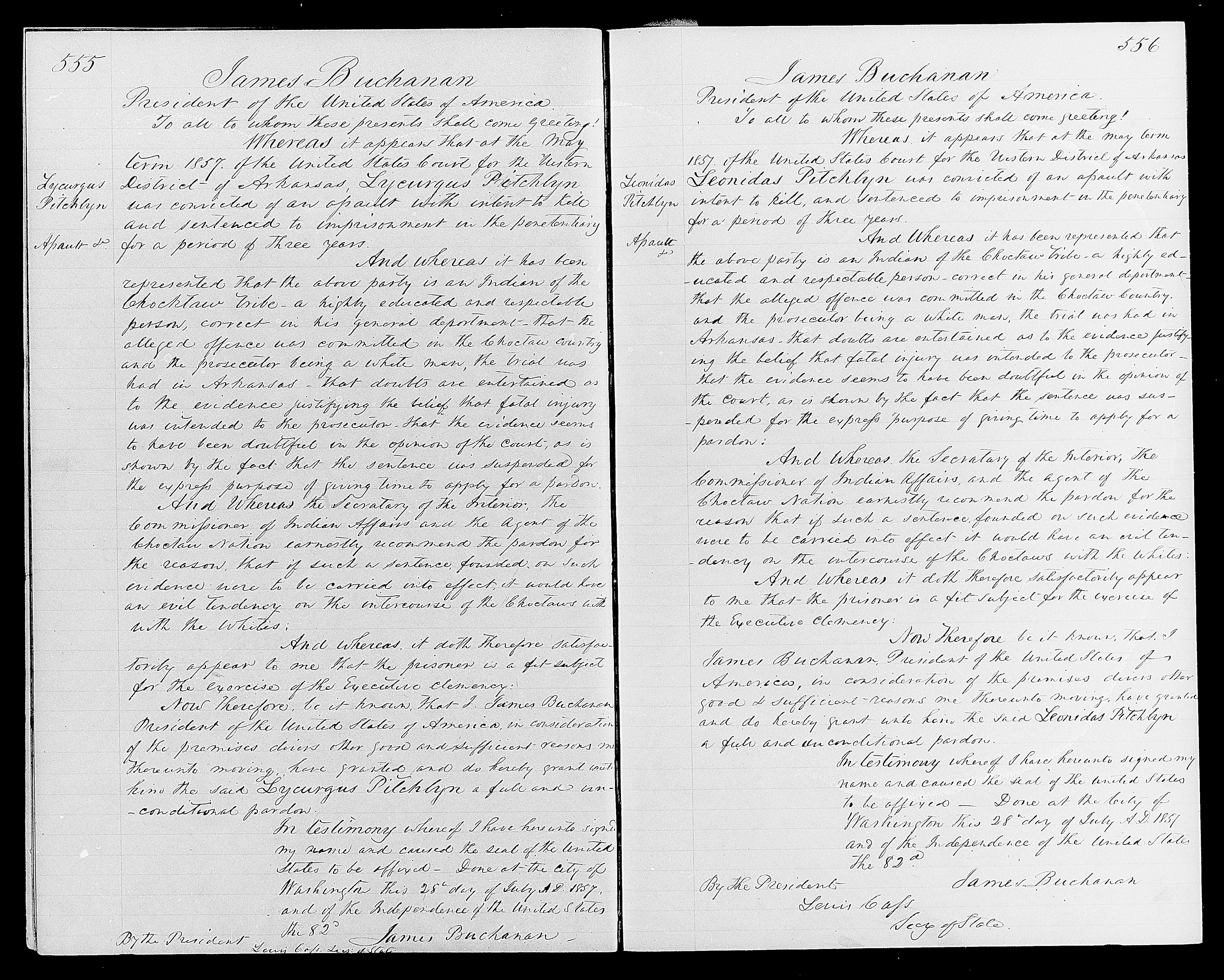
In 1857, President Buchanan, expressing qualms about the evidence, pardoned two sons of the Choctaw Delegate Peter Pitchlynn,51 both of whom had been convicted in the Western District of Arkansas of an offense committed in the Indian Territory.52
Under Article 5 of an 1830 treaty with the Choctaws:
The United States are obliged to protect the Choctaws from domestic strife and from forieghn (sic) enemies on the same principles that the citizens of the United States are protected, so that whatever would be a legal demand upon the U.S. for defence or for wrongs committed by an enemy, on a citizen of the U.S. shall be equally binding in favour of the Choctaws,…53
During debate on civil rights legislation54 in February 1866, Oregon Senator George Williams summarized federal superintendence of Indians in his state:
There are thousands of Indians in the State of Oregon. They are generally collected upon reservations. Some of these Indians are there by virtue of treaties; some are there in consequence of the Indian wars that have occurred from time to time in that country; and they are there, and held there by compulsion. The Government of the United States feeds, clothes, and takes care of these Indians, treats them as wards, treats them as incapable of self-government; and they are governed by such rules and regulations as are prescribed by the Government from time to time, and as the necessities of the case seem to require.55
Under an 1865 treaty proclaimed by the President in March 1867, the Confederated Tribes of Middle Oregon “covenant and agree that they will hereafter remain upon said reservation, subject to the laws of the United States, the regulations of the Indian Department, and the control of the officers thereof;…”56 In 1880, U.S. District Judge Matthew Deady, who had decided McKay v. Campbell in 1871,57 wrote, “There are no Indians in Oregon that were born subject to its jurisdiction or that have since become so.”58
The Supreme Court did not treat whether someone could be hauled into an American court as the animating principle of the Citizenship Clause in 1884 when it ruled in Elk v. Wilkins that the 14th Amendment did not make members of Indian tribes U.S. citizens at birth.59 The opinion in Elk never mentioned The Exchange. Apropos of the Citizenship Clause’s phrase “subject to the jurisdiction thereof,” Elk announces, “The evident meaning of these last words is, not merely subject in some respect or degree to the jurisdiction of the United States, but completely subject to their political jurisdiction, and owing them direct and immediate allegiance.”60
The two federal appellate panels that rejected the government’s appeals of preliminary injunctions against the executive order on citizenship at birth in other cases last year61 did not propose that The Exchange classifies members of Indian tribes as an exempt group. Nor did they suggest that Elk would have been wrongly decided if members of Indian tribes are “amenable to the laws” under The Exchange’s rubric.
Instead, the two panels nudged “subject to the jurisdiction thereof” onto Elk’s sliding scale. The 9th Circuit panel concluded that in Wong Kim Ark “the Court must have understood the phrase to refer to the United States’s ability to fully subject an individual to its laws.”62 The 1st Circuit panel suggested “the Clause refers to those actually subjected to United States law in full when “born . . . in the United States:””
Wong Kim Ark‘s discussion of The Exchange, when paired with its discussion of Elk, makes clear what was understood to be the coherent basis for concluding that children born Native American tribal members are not “subject to the jurisdiction” of the United States. Due to the peculiar quasi-sovereign status of tribes, the United States’s otherwise “full and absolute territorial jurisdiction” over those present here has been voluntarily waived as to tribal members (albeit in part, rather than in full) just as it has been waived (again, in part, rather than in full) in the special classes of cases -- involving “foreign ministers,” friendly “sovereigns or their armies,” and “public ships of war” -- in which “every nation” is understood to have waived “a part of it[].” Id. at 686.
This understanding of the phrase “subject to the jurisdiction thereof” also fits comfortably with the Citizenship Clause’s text. Even if there is potential ambiguity as to the scope of the words “subject to,” there is nothing strange about reading those words so that the Clause refers to those actually subjected to United States law in full when “born . . . in the United States” (as opposed to those, due to a sovereign waiver, merely potentially subjected to it in full, like the members of the aforementioned special classes). U.S. Const. amend. XIV, § 1.63
The 1st Circuit’s “sovereign waiver” theory is echoed in a contention about complete jurisdiction from the Barbara respondents:
…the exception for Native Americans illuminates what the Court meant by “complete” jurisdiction. The question is whether the United States has stayed its own sovereign jurisdictional hand to some significant degree in recognition of an inter-sovereign relationship.64
The term “inter-sovereign” seems to have been absent from district court proceedings in Barbara. Briefs incorporated in Barbara from New Hampshire Indonesian Community Support argued that “subject to the jurisdiction thereof” covers individuals who are “subject to the enforcement of United States law,”65 “subject to the legal authority of the United States,”66 “subject to the laws (including the immigration and criminal laws) of the United States,”67 and who ““owe[] obedience to the laws of [the] government, and may be punished for treason or other crimes.””68
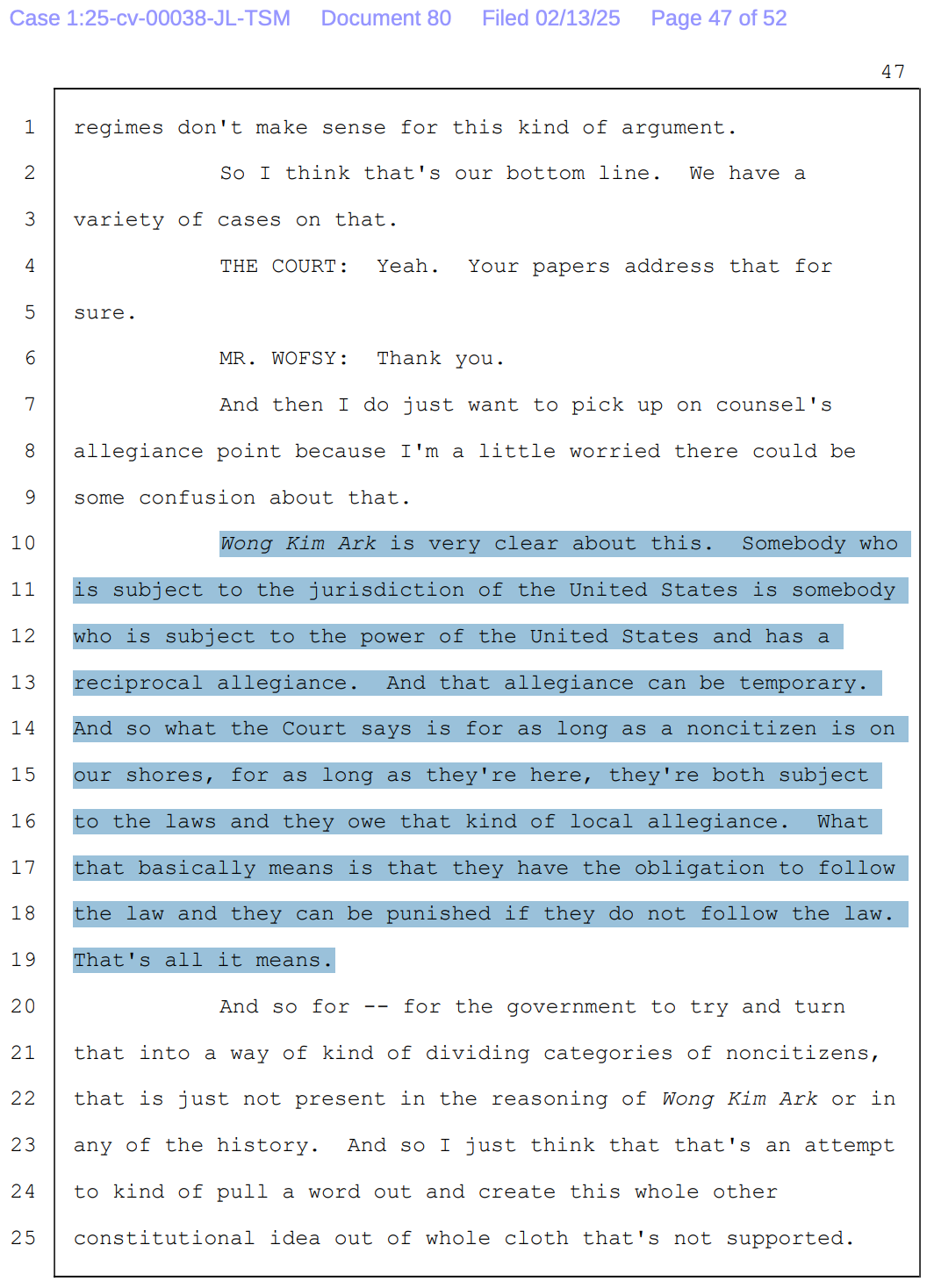
(At a February 2025 hearing in New Hampshire Indonesian Community Support, Cody Wofsy, now counsel of record for Barbara respondents,69 contended:
Wong Kim Ark is very clear about this. Somebody who is subject to the jurisdiction of the United States is somebody who is subject to the power of the United States and has a reciprocal allegiance. And that allegiance can be temporary. And so what the Court says is for as long as a noncitizen is on our shores, for as long as they’re here, they’re both subject to the laws and they owe that kind of local allegiance. What that basically means is that they have the obligation to follow the law and they can be punished if they do not follow the law. That’s all it means.70
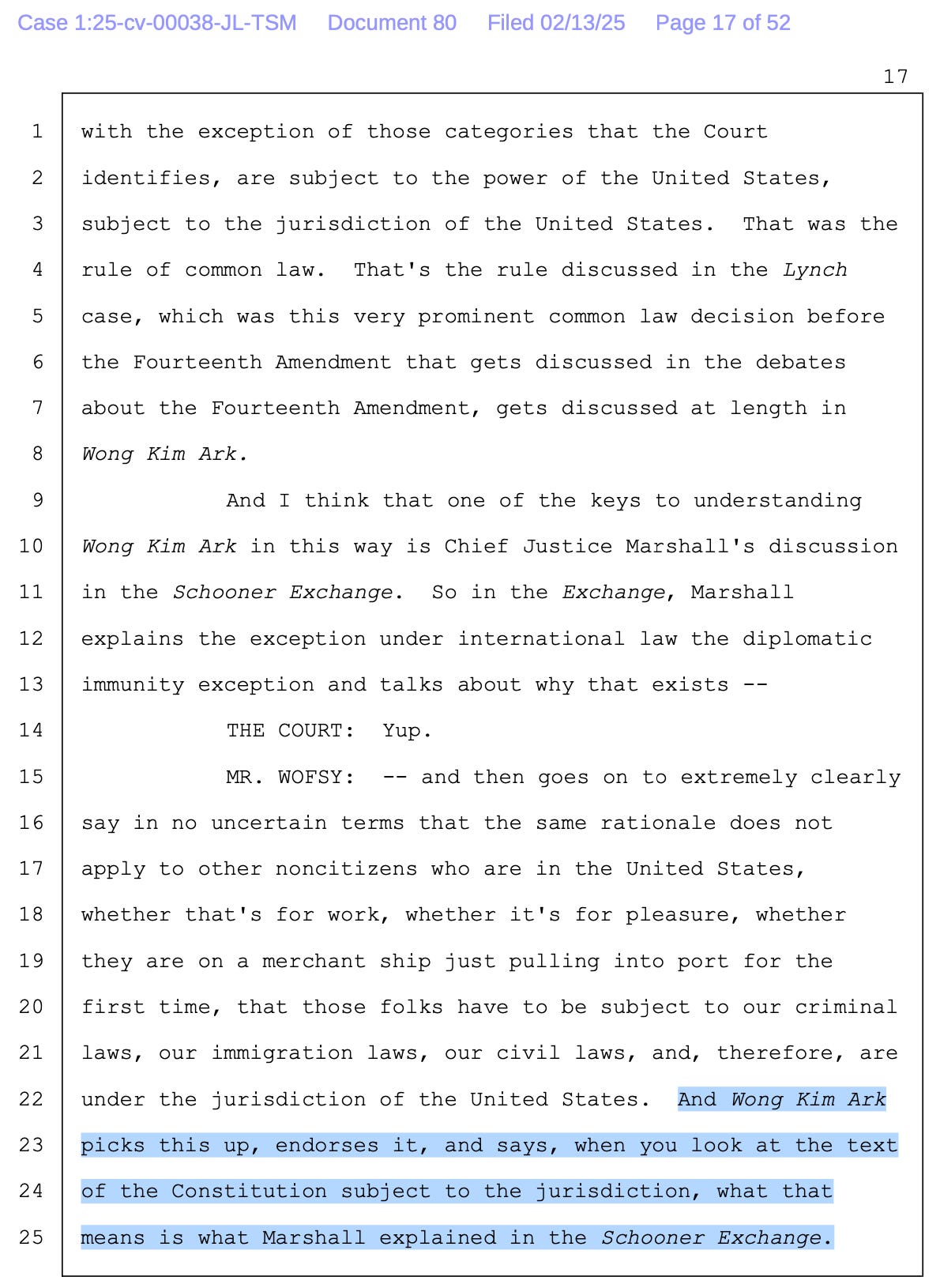
During the same hearing, Wofsy also stated, “And Wong Kim Ark picks this up, endorses it, and says, when you look at the text of the Constitution subject to the jurisdiction, what that means is what Marshall explained in the Schooner Exchange.”71
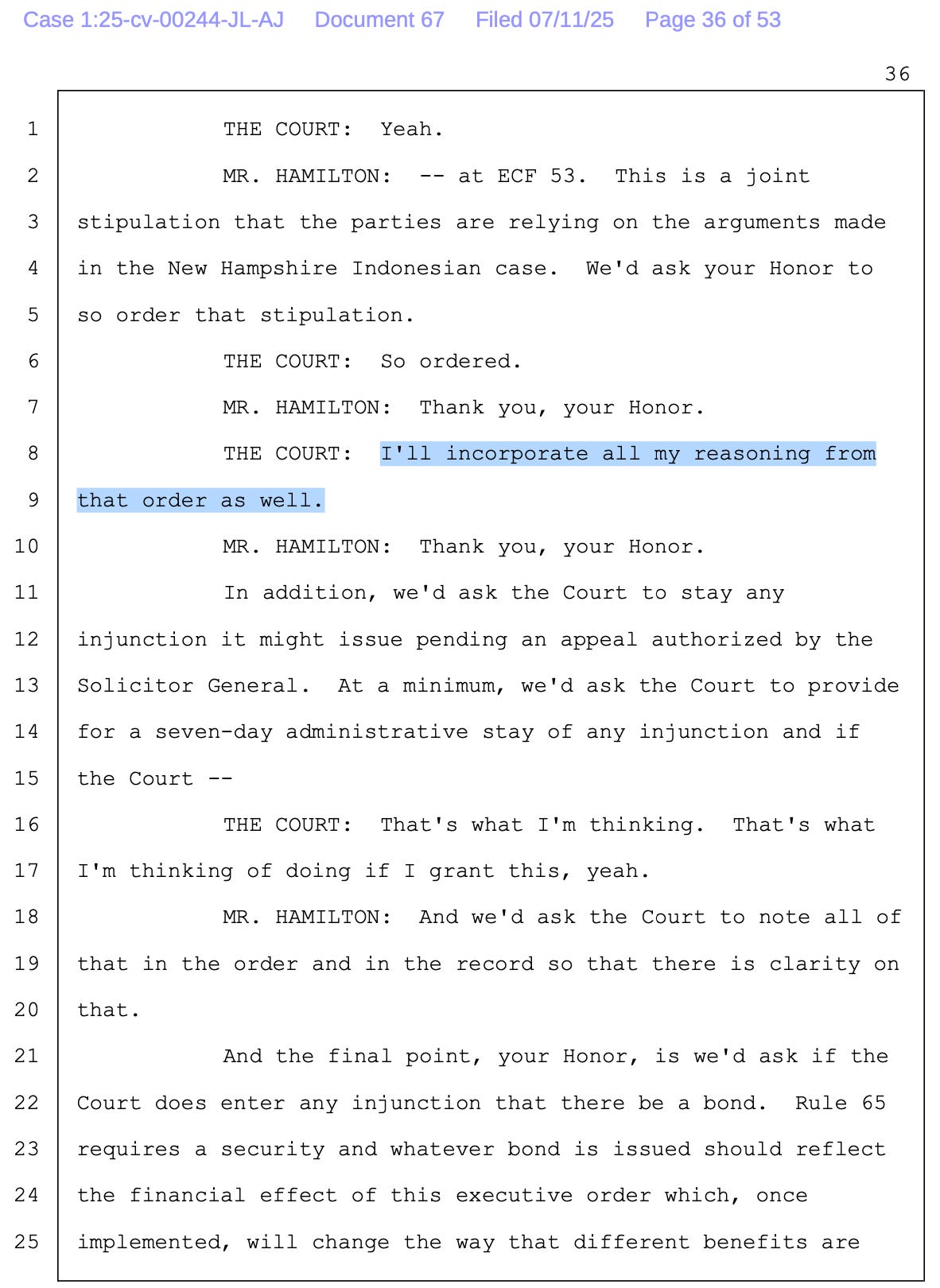
In New Hampshire Indonesian Community Support, U.S. District Judge Joseph Laplante ruled that Wofsy’s clients “advocate for the most natural reading of the phrase “subject to the jurisdiction thereof” employed by the Fourteenth Amendment and § 1401,” elaborating, “The amendment and statute are unambiguous, and the plaintiffs argue for the ordinary meaning of the phrase as understood by reasonable American English speakers at the time of enactment.”72 At a July 2025 hearing in Barbara, Judge Laplante, after ordering the incorporation of three briefs from New Hampshire Indonesian Community Support, stated, “I’ll incorporate all my reasoning from that order as well.”)73
Whatever “a fiction of extraterritoriality”74 might mean, it does not entail exemption from prosecution since it attaches to members of Indian tribes.
Postulate #2: Foreign consular officials possessing neither U.S. citizenship nor permanent residence are not completely subject to the United States’ political jurisdiction
If liability to prosecution is not the determinative factor under the Citizenship Clause, how should the Clause treat the children of foreign consular officials?
While foreign consuls do not ordinarily enjoy the immunities of diplomatic agents75 and have long been liable to prosecution in U.S. courts,76 they are not “ordinary foreign nationals.”77 The Constitution provides, “In all cases affecting ambassadors, other public ministers and consuls, and those in which a State shall be party, the Supreme Court shall have original jurisdiction.”78 Consuls enjoy official acts immunity under the 1963 Vienna Convention on Consular Relations.79 Along with their immediate family members, they are generally exempt from local taxation.80 (U.S. citizens or permanent residents authorized to serve as foreign consular officers within the U.S. also enjoy official acts immunity.)81
Since members of Indian tribes are liable to prosecution without being “subject to the jurisdiction” for purposes of the Citizenship Clause under Supreme Court precedent,82 the operation of the Citizenship Clause would not be uniform if consular officials’ liability to prosecution for acts unconnected with their official responsibility is what makes them “subject to the jurisdiction” for purposes of the Clause.
However, as one amicus brief in Barbara noted,83 the State Department put the fact that consuls were not diplomatic agents front and center in 1938 when it informed the French government of its reasons for considering the U.S.-born son of a French consular officer to be a U.S. citizen:
It has long been the view of the Department that under this Constitutional provision persons born in the United States of fathers who are in the employ of a foreign government other than in a diplomatic capacity are considered to be born subject to the jurisdiction of the United States and consequently acquire at birth the status of citizens of the United States.84
In the early-1870s, dicta in the Slaughter-House Cases suggested that the Citizenship Clause did not treat the children of foreign consuls as citizens at birth:
The phrase, “subject to its jurisdiction” was intended to exclude from its operation children of ministers, consuls, and citizens or subjects of foreign States born within the United States.85
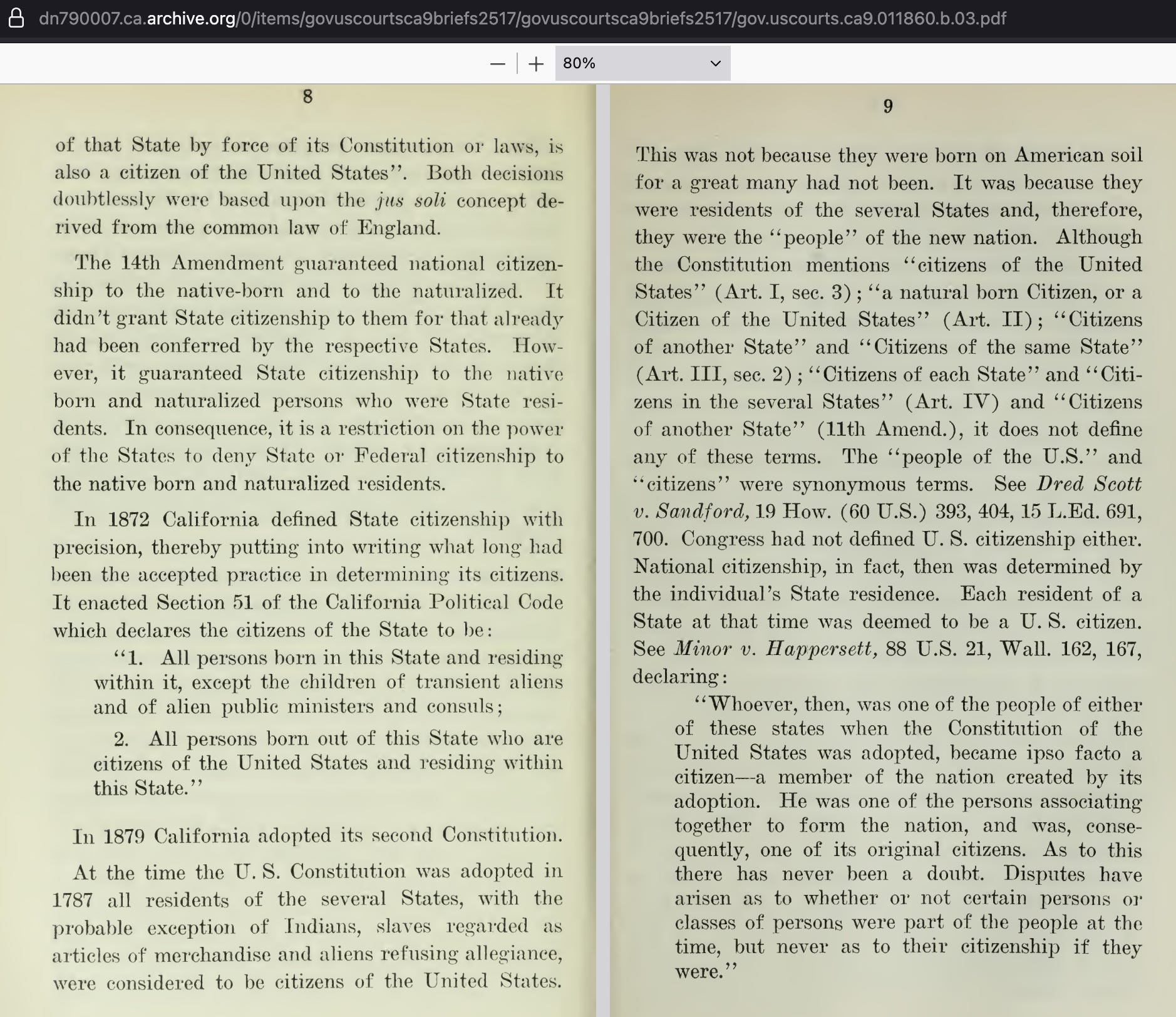
Under California’s 1872 Political Code, the California-born children of foreign consuls were not considered citizens of the state,86 as the American Civil Liberties Union of Northern California described in a 1948 amicus brief:
The 14th Amendment guaranteed national citizenship to the native-born and to the naturalized. It didn’t grant State citizenship to them for that already had been conferred by the respective States. However, it guaranteed State citizenship to the native born and naturalized persons who were State residents. In consequence, it is a restriction on the power of the States to deny State or Federal citizenship to the native born and naturalized residents.
In 1872 California defined State citizenship with precision, thereby putting into writing what long had been the accepted practice in determining its citizens. It enacted Section 51 of the California Political Code which declares the citizens of the State to be:
“1. All persons born in this State and residing within it, except the children of transient aliens and of alien public ministers and consuls;
2. All persons born out of this State who are citizens of the United States and residing within this State.”87
Wong Kim Ark’s evaluation of the consular dicta in the Slaughter-House Cases emphasized that consuls could be hauled into court:
This was wholly aside from the question in judgment, and from the course of reasoning bearing upon that question. It was unsupported by any argument, or by any reference to authorities; and that it was not formulated with the same care and exactness, as if the case before the court had called for an exact definition of the phrase, is apparent from its classing foreign ministers and consuls together—whereas it was then well settled law, as has since been recognized in a judgment of this court in which Mr. Justice Miller concurred, that consuls, as such, and unless expressly invested with a diplomatic character in addition to their ordinary powers, are not considered as entrusted with authority to represent their sovereign in his intercourse with foreign States or to vindicate his prerogatives, or entitled by the law of nations to the privileges and immunities of ambassadors or public ministers, but are subject to the jurisdiction, civil and criminal, of the courts of the country in which they reside.88
Two months after the State Department informed the French government of its reasons for considering the U.S.-born son of a French consular officer to be a U.S. citizen,89 the French Ambassador wrote to the Secretary of State inquiring about “a practical solution:”
I would be very grateful to Your Excellency if you would have the goodness to examine the question and, taking account of the decisions of the Supreme Court of the United States, let me know whether a practical solution could not be contemplated to the end that the children born in the United States to career agents of the French Consular List, on duty in this country, may not be considered as American citizens, at least if there is no express manifestation of desire on their part.90
The Secretary of State told the French Ambassador that the Citizenship Clause tied the U.S. government’s hands:
…I regret to say that there does not seem to be any practicable solution of the problem since citizenship is acquired by such children under a provision of the Constitution of the United States.91
In the 1970s, the State Department insisted that the U.S.-born children of Soviet consular officials were U.S. citizens since the expanded immunities Soviet consular officials enjoyed by treaty92 were not shared by their family members.93 In a 1975 letter to the Staff Director of the House Judiciary Committee, the Administrator of the Bureau of Security and Consular Affairs explained:
Therefore, children born in the United States to Soviet “non-diplomatic” employees are subject only to those immunities specifically enumerated in the 1964 Convention. Since no full immunity is granted by the Convention to the families of consular officers or employees, they are subject to U.S. jurisdiction and thus such children acquire United States citizenship at birth under the Fourteenth Amendment.
In view of your feelings and the feelings of the U.S.S.R. Government about this situation, we are exploring the possibilities of resolving this problem by means of a separate protocol agreement.94
(In 1986, the Soviet Embassy in Washington took the State Department up on its offer to exempt family members of consular officials from criminal process:
The Embassy regards as acceptable the proposal contained in the Department of State’s note, that on the basis of reciprocity the members of the families of consular officers and of employees residing with them who are nationals of the sending state shall enjoy immunity from the criminal jurisdiction of the receiving state, provided that these family members are not nationals of the receiving state and do not have in the receiving state the status of aliens lawfully admitted for permanent residence.
This Embassy note, together with the above-mentioned note of the Department of State, constitute an agreement that shall enter into force on the date of this note.95
A 2013 criminal complaint mentions a 2006 determination by the State Department that the U.S.-born child of a Russian official accredited as a trade and consular official was not a U.S. citizen.96 The complaint suggests that this determination was made on the strength of the 1986 diplomatic notes.97 If 1) the Citizenship Clause established “a closed set of exceptions,”98 2) the U.S.-born children of foreign consuls did not qualify for this closed set in 1868, and 3) the State Department properly concluded in 1975 that the Citizenship Clause granted citizenship at birth to the U.S.-born children of Soviet consular officials, then would it not be out of bounds to allow an exchange of diplomatic notes to upset the operation of a provision of the Constitution?
At oral argument last month, counsel for the Barbara respondents proposed that the Citizenship Clause’s exclusions relate to cases in which a foreign sovereign exercises its powers over its citizens or subjects while they are present in the United States:
Thirty years after ratification, this Court held that the Fourteenth Amendment embodies the English common law rule. Virtually everyone born on U.S. soil is subject to its jurisdiction and is a citizen.
It excludes only those cloaked with a fiction of extraterritoriality because they are subject to another sovereign’s jurisdiction even when they’re in the United States, a closed set of exceptions to an otherwise universal rule.99
The -- the difference between an ordinary non-ambassador foreign national and everyone who’s subject to one of those jurisdictions is that even if -- if you take the government’s argument and say a foreign national is subject to their country of nationality’s jurisdiction in the United States is actually not true.
If I’m a French national in the United States, France cannot come into the United States, arrest me, and try me for a crime under French law. And that’s what sets ordinary foreign nationals apart from ambassadors --100
Foreign consular officials who are tax-exempt and cannot be held liable for official acts performed in the U.S. pursuant to the instructions of a foreign government are far from completely subject to U.S. jurisdiction.
The Barbara respondents would likely rejoin that working out the extent to which a foreign consular official is subject to U.S. jurisdiction for purposes of the Citizenship Clause is entirely academic, as they have suggested that “the relevant allegiance was that of the child, not the parent.”101 Maxwell Evarts raised this argument in 1897, asserting, “Whether Wong Kim Ark was himself at the time of his birth subject to the jurisdiction of the United States does not depend upon whether his father was or not,…”102
The Wong Kim Ark majority opinion kept mum on this point, nor did it weigh in on Evarts’ contention that Wong Kim Ark’s father “had a right to invoke the aid of this nation against the Emperor of China, whose subject he was by birth.”103 One does not imagine Evarts proposing the latter argument had Wong Kim Ark’s father been a Chinese consular official.
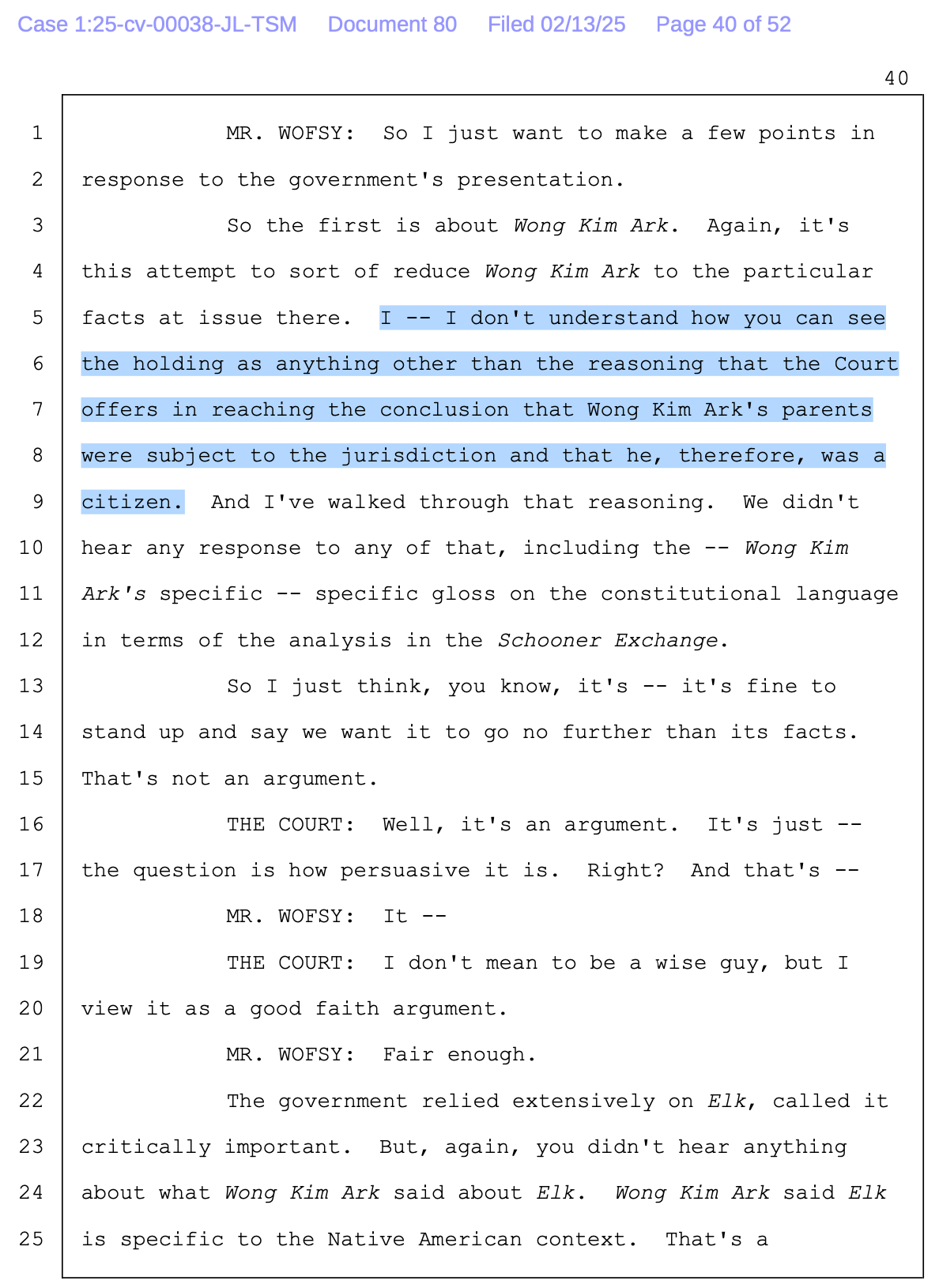
At the February 2025 hearing in New Hampshire Indonesian Community Support, Cody Wofsy told the district court that the Supreme Court’s “conclusion” in 1898 was that Wong Kim Ark’s citizenship at birth resulted from his parents’ subjection to U.S. jurisdiction:
I -- I don’t understand how you can see the holding as anything other than the reasoning that the Court offers in reaching the conclusion that Wong Kim Ark’s parents were subject to the jurisdiction and that he, therefore, was a citizen.104
Note, 5/30/26: grammatical error corrected.
U.S. Const., Amend. XIV, § 1, 15 stat. 709 (“All persons born or naturalized in the United States, and subject to the jurisdiction thereof, are citizens of the United States and of the State wherein they reside.”).
Brief for Respondents at 24, Trump v. Barbara, No. 25-365 (S. Ct. Feb. 19, 2026). See also Transcript of Oral Argument at 84-85, Trump v. Barbara, No. 25-365 (S. Ct. Apr. 1, 2026) (“MS. WANG: Well, Chief Justice, Mr. Chief Justice, I think we have to look at what the controlling rule of decision is in Wong Kim Ark. Justice Gray takes pains in the majority opinion to set out his analysis. He first starts with a premise that in construing the Fourteenth Amendment Citizenship Clause, we look to the English common law.
That was the rule that applied from the colonial era on at least for the colonists and for European immigrants.
He then says: Look, Chief Justice Marshall tells us in The Schooner Exchange what “subject to the jurisdiction” means, again looking to English common law.”) (emphasis added).
United States v. Wong Kim Ark, 169 U.S. 649, 693 (1898) (“The Fourteenth Amendment affirms the ancient and fundamental rule of citizenship by birth within the territory, in the allegiance and under the protection of the country, including all children here born of resident aliens, with the exceptions or qualifications (as old as the rule itself) of children of foreign sovereigns or their ministers, or born on foreign public ships, or of enemies within and during a hostile occupation of part of our territory, and with the single additional exception of children of members of the Indian tribes owing direct allegiance to their several tribes.”).
Brief for Respondents at 16, Trump v. Barbara, No. 25-365 (S. Ct. Feb. 19, 2026). See also Transcript of Oral Argument at 126, Trump v. Barbara, No. 25-365 (S. Ct. Apr. 1, 2026) (“JUSTICE BARRETT: So I have a question about the exceptions again. So, in your interchange with Justice Kavanaugh just now, you were talking about it as a closed set of exceptions. And said that way, it sounds like exceptions that people had in mind at the time of the ratification but that were not explicit in the amendment.
But I took your brief to be arguing that “subject to the jurisdiction thereof” is the language in the Fourteenth Amendment that refers to those exceptions. Am I right?
MS. WANG: That’s right.
JUSTICE BARRETT: Okay.
MS. WANG: It describes them.”).
Brief for Respondents at 6, Trump v. Barbara, No. 25-365 (S. Ct. Feb. 19, 2026). (“Elk v. Wilkins—which, like Wong Kim Ark, was written by Justice Gray—reinforces that conclusion. 112 U.S. 94 (1884). It illustrates that the English common-law exceptions for children of ambassadors and the like, and the analogous American exclusion of Native American tribal members, all rest on inter-sovereign dynamics inapplicable to ordinary foreign nationals, whether domiciled here or not. Id. at 99- 100.”).
The Schooner Exchange v. McFaddon, 11 U.S. 116, 140 (1812). (“The grant of a free passage, therefore, implies a waiver of all jurisdiction over the troops, during their passage, and permits the foreign general to use that discipline, and to inflict those punishments which the government of his army may require.”).
Brief for Respondents at 10-11, Trump v. Barbara, No. 25-365 (S. Ct. Feb. 19, 2026) (“In the landmark case Exchange, this Court applied the phrase “subject to the . . . jurisdiction” in terms of “allegiance” and its exceptions for certain foreigners. 11 U.S. at 142, 144 . Exchange explained that a visiting foreign king, for example, could not be understood to “subject himself to a jurisdiction incompatible with his dignity.” Id. at 137. Likewise, a “foreign minister[]” was granted “immunity” because he was considered “as in the place of the sovereign he represents, or by a political fiction . . . extraterritorial.” Id. at 138. But, critically, this “immunity” did not extend to “private individuals”: “[J]urisdiction”—that is, the reach of the laws—would extend to ordinary foreigners by virtue of their “temporary and local allegiance.” Id. at 138-39, 144.”).
Order Granting Preliminary Injunction and Provisional Class Certification at 29, Barbara v. Trump, No. 1:25-cv-00244-JL-AJ (D.N.H. July 10, 2025), ECF No. 65 (“Petitioners and respondents stipulated to incorporate by reference their prior briefing before this court in New Hampshire Indonesian Cmty. Support.”); Parties’ Stipulation Regarding Incorporation of Prior Briefing at 1-2, Barbara v. Trump, No. 1:25-cv-00244-JL-AJ (D.N.H. July 3, 2025), ECF No. 53 (“Thus, the parties stipulate to incorporate the briefing from the prior New Hampshire Indonesian Community Support action—i.e., New Hampshire Indonesian Community Support v. Trump, 1:25-cv-38-JL-TSM ECF Nos. 24-1, 58-1, 64 (D.N.H.)—regarding the merits of Plaintiffs’ request for a preliminary injunction so as to serve judicial economy and permit the parties to brief issues unique to the class action posture of this case—something not previously at issue in New Hampshire Indonesian Community Support.”); Transcript of Motion Hearing at 36, Barbara v. Trump, No. 1:25-cv-00244-JL-AJ (D.N.H. July 10, 2025 [filed July 11, 2025]), ECF No. 67 (“MR. HAMILTON: -- at ECF 53. This is a joint stipulation that the parties are relying on the arguments made in the New Hampshire Indonesian case. We’d ask your Honor to so order that stipulation.
THE COURT: So ordered.
MR. HAMILTON: Thank you, your Honor.
THE COURT: I’ll incorporate all my reasoning from that order as well.”).
Plaintiffs’ Reply in Support of Motion for Preliminary Injuction (sic) at 6-7, New Hampshire Indonesian Community Support v. Trump, No. 1:25-cv-00038-JL-TSM (D.N.H. Feb. 4, 2025), ECF No. 64.
Brief for Respondents at 6, Trump v. Barbara, No. 25-365 (S. Ct. Feb. 19, 2026) (emphasis added). See also Transcript of Oral Argument at 85, Trump v. Barbara, No. 25-365 (S. Ct. Apr. 1, 2026) (“The purpose of the Fourteenth Amendment was to embrace that universal rule of birthright citizenship, to embrace and incorporate the common law exceptions, with the single additional exception of the preexisting exception for tribal Indians that we had in the United States, which is an analogous exception, and that’s the closed set of exceptions.”).
Doe et al. v. Trump et al., Nos. 25-1169 and 25-1170, slip op. at 64 (1st Cir. Oct. 3, 2025) (reported at 157 F. 4th 36) (“Noting that The Exchange concerned “the grounds upon which foreign ministers are, and other aliens are not, exempt from the jurisdiction of this country,” Justice Gray explained that Chief Justice Marshall had no occasion to address “the anomalous case of the Indian tribes” or the “suspension of the sovereignty of the United States over part of their territory by reason of a hostile occupation.” Id. at 683.”) (italics substituted for underlining in original) (citing United States v. Wong Kim Ark, 169 U.S. 649, 683 (1898).
An Act for well Ordering and Governing the Indians in this Colony ; and securing their Interests and Lands therein, Acts and Laws of His Majesty’s English Colony of Connecticut in New-England in America at 96 (New-London: 1750) (“That the Authority and Select-men of each Town wherein there are any Indians living or residing, shall take Care, and they are hereby directed to endeavour to assemble and convene such Indians, annually, and acquaint them with the Laws of the Government made for punishing such Immoralities as they may be guilty of ; and make them sensible that they are not exempted from the Penalties of such Laws any more than His Majesty’s other Subjects in the Colony are.”).
For example, Treaty with the Wyandots, Etc., proclaimed Sep. 27, 1789, Art. 5, 7 stat. 28, 29 (“It is agreed that if any Indian or Indians of the nations before mentioned, shall commit a murder or robbery on any of the citizens of the United States, the nation or tribe to which the offender belongs, on complaint being made, shall deliver up the person or persons complained of, at the nearest post of the United States; to the end, that he or they may be tried, and if found guilty, punished according to the laws established in the territory of the United States north-west of the river Ohio, for the punishment of such offences, if the same shall have been committed within the said territory; or according to the laws of the State where the offence may have been committed, if the same has happened in any of the United States.”); Treaty with the Sacs and Foxes, proclaimed Feb. 21, 1805, Art. 5, 7 stat. 84, 85 (“And it shall be the duty of the said chiefs upon complaint being made as aforesaid to deliver up the person or persons against whom the complaint is made, to the end that he or they may be punished agreeably to the laws of the state or territory where the offence may have been committed;…”); Treaty with the Miewakanton and Wahpekuta Sioux Indians, proclaimed Mar. 31, 1859, Art. 6, 12 stat. 1031, 1034 (“They also agree to deliver to the proper officers all persons belonging to their said bands who may become offenders against the treaties, laws, or regulations of the United States, or the laws of the State of Minnesota, and to assist in discovering, pursuing, and capturing all such offenders whenever required so to do by such officers, through the agent or other proper officer of the Indian department.”).
Torladé v. Barrozo, 1 Miles 366, 376 (Phila. D. Ct. 1830) (“The single question now to be determined is, Has the defendant established his claim of privilege as chargé d’affaires of the kingdom of Portugal, so as to entitle him to be discharged from the process issued against him?
That foreign ambassadors and other public ministers, including the grade of chargé d’affaires, are invested with an inviolability of character, immunities and privileges, exempting their persons and their property from the jurisdiction and authority of the state near which they reside, by the laws of nations and the statutes of our country, cannot be a subject of debate. Under ordinary circumstances it would appear that we have rather to determine a question of fact, viz. : is the defendant invested with the diplomatic character he alleges ; and not, whether, being chargé d’affaires of a foreign government, he is privileged from arrest and suit.”); Thomas Jefferson to Zebulon Hollingsworth (June 25, 1793), Founders Online, National Archives. [Original source: The Papers of Thomas Jefferson, vol. 26, 11 May–31 August 1793, ed. John Catanzariti. Princeton: Princeton University Press, 1995, p. 363.] (“It is unnecessary for me to observe to you, Sir, that in this country the person and dwelling of a public minister, are alone exempted from arrest, and that the pretence is without foundation which would extend that exemption to a foreign officer or foreign vessel.”).
Chapter 31 (Mar. 12, 1803), Laws of the State of New-York, Passed at the Twenty-Sixth Session of the Legislature at 64-65 (Albany: 1803).
Thomas Jefferson to Farmer’s Brother and Others, (Feb. 14, 1803), Founders Online, National Archives (footnote number omitted). [Original source: The Papers of Thomas Jefferson, vol. 39, 13 November 1802–3 March 1803, ed. Barbara B. Oberg. Princeton: Princeton University Press, 2012, pp. 514–518.]
Chapter 204 (Apr. 12, 1822), Laws of the State of New-York passed at the Forty-Fifth, Forty-Sixth and Forty-Seventh Sessions of the Legislature, Vol. VI at 202 (Albany: 1825); Amanda M. Murphy, A Tale of Three Sovereigns: The Nebulous Boundaries of the Federal Government, New York State, and the Seneca Nation of Indians Concerning State Taxation of Indian Reservation Cigarette Sales to Non-Indians, 79 Fordham L. Rev. 2301, 2314-2315 (2011); Hatch v. Luckman, 118 N.Y.S. 689, 694-695 (N.Y. Sup. Ct. 1909); State v. Foreman, 8 Yer. 256, 16 Tenn. 256, 323 (1835) (“The statute of New York had the sanction of the executive, legislative and judiciary departments of that government; and these filled with men standing high for legal and political learning to a very uncommon extent; and is entitled to great regard as an authority in favor of State jurisdiction.”). See also Haaland v. Brackeen, 599 U. S. 255, 357 (2023) (Thomas, J., dissenting) (“As noted, when Congress tried to expand its domain in 1817 to regulate the criminal acts of Indians, one Justice of this Court found it to be a palpable violation of Congress’ limited powers. See Bailey, 24 F. Cas., at 938–940. And, all the while, States continued to regulate matters relating to Indians within their territorial limits. The normal federalist dynamic thus extended to the domain of Indian affairs: The Federal Government was supreme with respect to its enumerated powers, but States retained all residual police powers within their territorial borders.”).
Letter from the Governor of the Michigan Territory to the Secretary of State (Nov. 13, 1806), in Collections and Researches Made by the Michigan Pioneer and Historical Society, Vol. 31 at 570 (1902).
Transactions of the Supreme Court of the Territory of Michigan, 1805-1814, Vol. 1 at 369 (William Wirt Blume ed. 1935).
The Territorial Papers of the United States, Volume X: The Territory of Michigan, 1805-1820 at 79 n. 26 (Clarence Edwin Carter comp., ed. 1942). See also Letter from the Governor of the Michigan Territory to the Secretary of State (Jan. 2, 1807), in Collections and Researches Made by the Michigan Pioneer and Historical Society, Vol. 31 at 583 (1902).
Copy of the Pardon of Michonee (Dec. 1806), National Archives Microfilm Publications, Microcopy No. T-967, Copies of Presidential Pardons and Remissions, 1794-1893, Roll 1, Volume 1 at 124, April 15, 1794 - November 19, 1812, NAID: 423380739 (“Whereas it has been made to appear to me that in the month of November last a Homicide was committed in the Territory of Michegan, upon the body of an Indian of the Chipawa Nation by Michonee, the principal chief thereof: Now be it known that for divers good causes and considerations me thereto moving, I have remitted, released and pardoned to the said Michonee the Homicide aforesaid, and all pains and penalties by him incurred by reason thereof; willing and requiring all prosecutions & proceedings to be forthwith stayed and discharged.”).
Collections and Researches Made by the Michigan Pioneer and Historical Society, Vol. 31 at 517 (1902).
State ex rel. Truman v. McKenney, 18 Nev. 182, 208 (1883) (“If by reason of the tribal organization of the Shawnees, recognized by the government, Kansas, under her act of admission, could not subject their property to taxation, because she accepted her admission on condition that the existing indian rights should remain unimpaired, and the general government be at liberty to make any regulations respecting rights of.person and property, how can it be said that, under the same restrictions, rights of far greater value may be interfered with ?”). See also The Kansas Indians, 72 U.S. (5 Wall.) 737, 755 (1867) (“If the tribal organization of the Shawnees is preserved intact, and recognized by the political department of the government as existing, then they are a “people distinct from others,” capable of making treaties, separated from the jurisdiction of Kansas, and to be governed exclusively by the government of the Union. If under the control of Congress, from necessity there can be no divided authority.”) (emphasis added).
Message of the Governor of Oregon, to the Legislative Assembly Thereof, 6th Regular Session, Sep. 1870 at 17 (1870).
Copy of the Pardon of Wa-ni-ga and Chick-hong-sic (Nov. 3, 1828), National Archives Microfilm Publications, Microcopy No. T-967, Copies of Presidential Pardons and Remissions, 1794-1893, Roll 1, Volume 4 at 208, March 18, 1822 - February 25, 1836, NAID: 423380739.
Copy of a letter from the Governor of the Michigan Territory to Judge Doty (July 5, 1828), National Archives Microfilm Publications, Microcopy No. 234, Letters Received by the Office of Indian Affairs, 1824-81, Roll 931, Winnebago Agency, 1826-1875, 1826-1847, NAID: 164549291.
Copy of the Transcript from the Record of the Proceedings of the Circuit Court of the United States in and for the County of Crawford, Territory of Michigan (Sep. 1-2, 1828), National Archives Microfilm Publications, Microcopy No. 234, Letters Received by the Office of Indian Affairs, 1824-81, Roll 931, Winnebago Agency, 1826-1875, 1826-1847, NAID: 164549291.
Act of Mar. 3, 1817, ch. 92, 3 stat. 383, 383. See also Haaland v. Brackeen, 599 U. S. 255, 348 (2023) (Thomas, J., dissenting) (“That general jurisdictional line held until 1817, when Congress first enacted a statute to impose penalties on anyone who committed a crime against a U. S. citizen while on Indian lands. See 3 Stat. 383. But Justice McLean, riding circuit, held that statute unconstitutional in 1834—at least as it applied to Indian lands located within the territorial limits of a State. See United States v. Bailey, 24 F. Cas. 937 (No. 14,495) (CC Tenn.).”).
Remonstrance of Col. Peter Pitchlynn, Choctaw Delegate, against the passage of the bill to unite under one government the several Indian tribes west of the Mississippi river, H.R. Mis. No. 35, 30th Cong., 2nd sess. (1849).
Copies of the Pardons of Lycurgus and Leonidas Pitchlyn (sic) (July 28, 1857), National Archives Microfilm Publications, Microcopy No. T-967, Copies of Presidential Pardons and Remissions, 1794-1893, Roll 2, Volume 6 at 555-556, April 19, 1847 - September 8, 1857, NAID: 423381294.
Treaty with the Confederated Tribes of Middle Oregon, proclaimed Mar. 28, 1867, Art. 2, 14 stat. 751, 751 (emphasis added).
McKay v. Campbell, 16 F. Cas. 161 (1871).
State of Washington et al. v. Trump et al., No. 25-807, slip op. (9th Cir. July 23, 2025) (reported at 145 F.4th 1013); Doe et al. v. Trump et al., Nos. 25-1169 and 25-1170, slip op. (1st Cir. Oct. 3, 2025) (reported at 157 F. 4th 36).
State of Washington et al. v. Trump et al., No. 25-807, slip op. at 28-29 (9th Cir. July 23, 2025) (reported at 145 F.4th 1013) (“Because the Court in Wong Kim Ark reasoned that the words “subject to the jurisdiction thereof” must be understood “in the same sense in which the like words had been used by Chief Justice Marshall in the well known case of The Exchange,” the Court must have understood the phrase to refer to the United States’s ability to fully subject an individual to its laws.”).
Doe et al. v. Trump et al., Nos. 25-1169 and 25-1170, slip op. at 71-72 (1st Cir. Oct. 3, 2025) (reported at 157 F. 4th 36) (italics substituted for underlining in original).
Memorandum of Law in Support of Plaintiffs’ Motion for Preliminary Injunction at 5, New Hampshire Indonesian Community Support v. Trump, No. 1:25-cv-00038-JL-TSM (D.N.H. Jan. 21, 2025), ECF No. 24-1 (“The Court explained that the Fourteenth Amendment’s requirement that children born in the United States must be “subject to the jurisdiction thereof” to qualify as citizens was crafted to exclude only children who were not subject to the United States’ jurisdiction because they and their parents were not subject to criminal and civil enforcement under the United States’ laws. 169 U.S. at 693. Wong Kim Ark and his parents were plainly subject to the enforcement of United States law; he, therefore, was a citizen.”).
Memorandum of Law in Support of Plaintiffs’ Motion for Preliminary Injunction at 9, New Hampshire Indonesian Community Support v. Trump, No. 1:25-cv-00038-JL-TSM (D.N.H. Jan. 21, 2025), ECF No. 24-1 (“By that point, it was universally understood that Wong Kim Ark had interpreted the term “subject to the jurisdiction” to mean everyone who was subject to the legal authority of the United States— including temporary visitors and unauthorized immigrants.”).
Memorandum of Law in Support of Plaintiffs’ Motion for Preliminary Injunction at 8, New Hampshire Indonesian Community Support v. Trump, No. 1:25-cv-00038-JL-TSM (D.N.H. Jan. 21, 2025), ECF No. 24-1 (“They are subject to the laws (including the immigration and criminal laws) of the United States, and therefore they and their children are subject to its jurisdiction.”).
Plaintiffs’ Reply in Support of Motion for Preliminary Injuction (sic) at 7, New Hampshire Indonesian Community Support v. Trump, No. 1:25-cv-00038-JL-TSM (D.N.H. Feb. 4, 2025), ECF No. 64 (“Such families plainly “owe[] obedience to the laws of [the] government, and may be punished for treason or other crimes,” and thus are “subject to the jurisdiction of the United States” under Wong Kim Ark’s analysis.”).
Transcript of Motion for Preliminary Injunction at 47, New Hampshire Indonesian Community Support v. Trump, No. 1:25-cv-00038-JL-TSM (D.N.H. Feb. 10, 2025 [filed Feb. 13, 2025]), ECF No. 80 (emphasis added).
Transcript of Motion for Preliminary Injunction at 17, New Hampshire Indonesian Community Support v. Trump, No. 1:25-cv-00038-JL-TSM (D.N.H. Feb. 10, 2025 [filed Feb. 13, 2025]), ECF No. 80.
Preliminary Injunction Order at 8, New Hampshire Indonesian Community Support et al. v. Trump, No. 1:25-cv-00038-JL-TSM (D.N.H. Feb. 11, 2025), ECF No. 79 (reported at 765 F. Supp. 3d 102) (“The plaintiffs advocate for the most natural reading of the phrase “subject to the jurisdiction thereof” employed by the Fourteenth Amendment and § 1401. “[I]t’s a fundamental canon of statutory construction that words generally should be interpreted as taking their ordinary ... meaning ... at the time Congress enacted the statute.” New Prime Inc. v. Oliveira, 586 U.S. 105, 113 (2019) (citations and quotations omitted). The amendment and statute are unambiguous, and the plaintiffs argue for the ordinary meaning of the phrase as understood by reasonable American English speakers at the time of enactment.”).
Transcript of Motion Hearing at 36, Barbara v. Trump, No. 1:25-cv-00244-JL-AJ (D.N.H. July 10, 2025 [filed July 11, 2025]), ECF No. 67 (“MR. HAMILTON: -- at ECF 53. This is a joint stipulation that the parties are relying on the arguments made in the New Hampshire Indonesian case. We’d ask your Honor to so order that stipulation.
THE COURT: So ordered.
MR. HAMILTON: Thank you, your Honor.
THE COURT: I’ll incorporate all my reasoning from that order as well.”) (emphasis added). See also Order Granting Preliminary Injunction and Provisional Class Certification at 30-31, Barbara v. Trump, No. 1:25-cv-00244-JL-AJ (D.N.H. Jul. 10, 2025), ECF No. 65 (“This court finds, as it did in New Hampshire Indonesian Cmty. Support, that the Executive Order likely “contradicts the text of the Fourteenth Amendment and the century-old untouched precedent that interprets it.” 765 F. Supp. 3d at 109. Further, the “Executive Order also likely violates § 1401, which codified the pertinent language from the Fourteenth Amendment.” Id. at 110.”).
Transcript of Oral Argument at 81, Trump v. Barbara, No. 25-365 (S. Ct. Apr. 1, 2026). (“Thirty years after ratification, this Court held that the Fourteenth Amendment embodies the English common law rule. Virtually everyone born on U.S. soil is subject to its jurisdiction and is a citizen.
It excludes only those cloaked with a fiction of extraterritoriality because they are subject to another sovereign’s jurisdiction even when they’re in the United States, a closed set of exceptions to an otherwise universal rule.”).
Letter from the Secretary of State to the U.S. attorney for the district of Massachusetts (Sep. 2, 1793), File Microcopies of Records in the National Archives: No. 40, Roll 5, Domestic Letters of the Department of State, Volume 5 at 244, February 4, 1792 - December 31, 1793, NAID: 29719035 (“You know that by the Law of Nations, Consuls are not diplomatic Characters, and have no immunities whatever against the laws of the Land.”).
Brief for Respondents at 6, Trump v. Barbara, No. 25-365 (S. Ct. Feb. 19, 2026). (“Elk v. Wilkins—which, like Wong Kim Ark, was written by Justice Gray—reinforces that conclusion. 112 U.S. 94 (1884). It illustrates that the English common-law exceptions for children of ambassadors and the like, and the analogous American exclusion of Native American tribal members, all rest on inter-sovereign dynamics inapplicable to ordinary foreign nationals, whether domiciled here or not. Id. at 99-100.”); Transcript of Oral Argument at 130, Trump v. Barbara, No. 25-365 (S. Ct. Apr. 1, 2026) (“The -- the difference between an ordinary non-ambassador foreign national and everyone who’s subject to one of those jurisdictions is that even if -- if you take the government’s argument and say a foreign national is subject to their country of nationality’s jurisdiction in the United States is actually not true.
If I’m a French national in the United States, France cannot come into the United States, arrest me, and try me for a crime under French law. And that’s what sets ordinary foreign nationals apart from ambassadors --”).
Vienna Convention on Consular Relations, entered into force Dec. 24, 1969, Art. 43(1), 21 UST 77, 104-105 (“Consular officers and consular employees shall not be amenable to the .jurisdiction of the judicial or administrative authorities of the receiving State in respect of acts performed in the exercise of consular functions.”).
Vienna Convention on Consular Relations, entered into force Dec. 24, 1969, Art. 49(1), 21 UST 77, 108. (“Consular officers and consular employees and members of their families forming part of their households shall be exempt from all dues and taxes, personal or real, national, regional or municipal, except:
(a) indirect taxes of a kind which are normally incorporated in the price of goods or services;
(b) dues or taxes on private immovable property situated in the territory of the receiving State, subject to the provisions of Article 32;
(c) estate, succession or inheritance duties, and duties on transfers, levied by the receiving State, subject to the provisions of paragraph (b) of Article 51;
(d) dues and taxes on private income, including capital gains, having its source in the receiving State and capital taxes relating to investments made in commercial or financial undertakings in the receiving State;
(e) charges levied for specific services rendered;
(f) registration, court or record fees, mortgage dues and stamp duties, subject to the provisions of Article 32.”).
Vienna Convention on Consular Relations, entered into force Dec. 24, 1969, Art. 71(1), 21 UST 77, 119-120. (“Except in so far as additional facilities, privileges and immunities may be granted by the receiving State, consular officers who are nationals of or permanently resident in the receiving State shall enjoy only immunity from jurisdiction and personal inviolability in respect of official acts ‘performed in the exercise of their functions, and the privilege provided in paragraph 3 of Article 44.”).
Brief of Citizenship Law Scholars as Amici Curiae Supporting Respondents at 14 n. 8, Trump v. Barbara, No. 25-365 (S. Ct. Feb. 18, 2026) (“Accord 8 Whiteman, Digest of International Law 125 (1967) (quoting 1938 State Department correspondence explaining that French consul’s child born in New York was a U.S. citizen because consuls lacked diplomatic status and were “subject to the jurisdiction, civil and criminal, of the courts of the country in which they reside” (quoting Wong Kim Ark, 169 U.S. at 679)).”).
Letter from the Secretary of State to the French Chargé (Mar. 3, 1938), Foreign relations of the United States, Diplomatic Papers, 1938, Volume II at 349 (H.R. Doc. No. 473, 76th Cong., 1st sess., GPO, 1955).
Brief of Amicus Curiae in Support of Appellant at 8, Fook v. Wixon, No. 11,860 (9th Cir. filed Apr. 3, 1948).
Letter from the Secretary of State to the French Chargé (Mar. 3, 1938), Foreign relations of the United States, Diplomatic Papers, 1938, Volume II at 349 (H.R. Doc. No. 473, 76th Cong., 1st sess., GPO, 1955).
Letter from the French Ambassador to the Secretary of State (May 5, 1938), Foreign relations of the United States, Diplomatic Papers, 1938, Volume II at 351 (H.R. Doc. No. 473, 76th Cong., 1st sess., GPO, 1955).
Letter from the Secretary of State to the French Ambassador (May 25, 1938), Foreign relations of the United States, Diplomatic Papers, 1938, Volume II at 352 (H.R. Doc. No. 473, 76th Cong., 1st sess., GPO, 1955).
USSR: Consular Convention and Protocol, entered into force July 13, 1968, Art. 19, 19 UST 5018, 5031-5032. (“1. Consular officers shall not be subject to the jurisdiction of the receiving state in matters relating to their official activity. The same applies to employees of the consular establishment, if they are nationals of the sending state.
2. Consular officers and employees of the consular establishment who are nationals of the sending state shall enjoy immunity from the criminal jurisdiction of the receiving state.
3. This immunity from the criminal jurisdiction of the receiving state of consular officers and employees of the consular establishment of the sending state may be waived by the sending state. Waiver must always be express.”).
USSR: Consuls, entered into force Oct. 31, 1986, TIAS 11432(4).
Complaint at 59 (¶ 110), United States v. Kuleshov et al., No. 1:13-mj-02711 (S.D.N.Y. Nov 18, 2013).
Complaint at 15 (¶ 15d), United States v. Kuleshov et al., No. 1:13-mj-02711 (S.D.N.Y. Nov 18, 2013). (“As a result of an international convention among multiple nations and a bilateral agreement between the United States and Russia, children born in the United States to Russian diplomats generally do not acquire United States citizenship.”).
Transcript of Oral Argument at 81, Trump v. Barbara, No. 25-365 (S. Ct. Apr. 1, 2026) (“Thirty years after ratification, this Court held that the Fourteenth Amendment embodies the English common law rule. Virtually everyone born on U.S. soil is subject to its jurisdiction and is a citizen.
It excludes only those cloaked with a fiction of extraterritoriality because they are subject to another sovereign’s jurisdiction even when they’re in the United States, a closed set of exceptions to an otherwise universal rule.”).
Transcript of Motion for Preliminary Injunction at 40, New Hampshire Indonesian Community Support v. Trump, No. 1:25-cv-00038-JL-TSM (D.N.H. Feb. 10, 2025 [filed Feb. 13, 2025]), ECF No. 80.